How Long Do Ads Run? Data From Meta's and Google's Ad Libraries
Most guides to ad libraries, ours included, repeat the same rule: if a competitor's ad has been running for a long time, it's probably working. Fair enough. But almost nobody puts a number on "a long time", so we measured it.
On 1 November 2026 we pulled the ads of 42 advertisers, from ASOS and Boots to Grind and Plum, out of Meta's Ad Library and Google's Ads Transparency Center, both set to the UK. That gave us run dates for about 7,000 ads, plus the Meta library's own counts of the 233,216 ads these brands ran in the UK over the past year.
The answer depends almost entirely on the platform.
The short version
- Most Meta ads stop within a month. Ads these brands had just stopped, mostly in the last days of October, had run for a median of 15 days. 70% had stopped within 30 days, 96% within 90 days, and none of the 1,518 had lasted a year.
- Long-running Meta ads are rare. Of the 9,663 ads these advertisers had live on 1 November, 278 (2.9%) had been running for 90 days or more. Seven had been running for over a year. Half the advertisers had no live ad that old.
- Google ads last far longer. Half the brands' live Google ads had been running for more than a year, and 89 of them since at least October 2021. Search text ads had a median age of 464 days.
- The same brands run longer on Google. For the 10 advertisers where we could see stopped ads on both platforms, their Google ads ran a median of 29 days before stopping. Their Meta ads ran 8.
- The first page of an advertiser's ads leans long. The first 30 stopped ads the Meta library lists for each advertiser had a median run of 41 days, nearly three times the real figure.
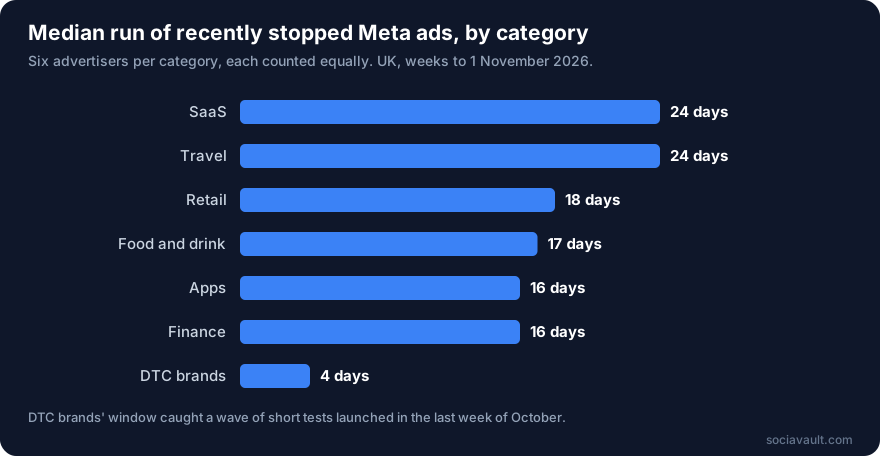
- Travel ran longest, DTC brands shortest. That held on both platforms.
What the libraries show, and why LinkedIn isn't here
Meta's Ad Library is a public transparency tool, and anyone can search it without an account. For each ad, our company ads endpoint returns start_date and end_date (Unix seconds, rounded to the day) and is_active. For a live ad, end_date is today.
We used the UK library on purpose. As we found in our Black Friday ads study, the US library stops listing commercial ads once they stop running, while ads shown in the UK stay listed for about a year after they last ran. You can't measure how long ads ran if the stopped ones aren't there.
Google's Ads Transparency Center gives each ad a firstShown and lastShown timestamp, which our Google company ads endpoint returns as ISO dates. There's no active flag, so we counted an ad as live if Google had shown it in the 48 hours before our pull. In practice 97.7% of those had been shown in the last 24 hours.
We wanted LinkedIn as well. Its library has startDate, endDate and a readable adDuration ("Ran from Oct 27, 2026 to Oct 31, 2026"), but only some ads carry them. On HubSpot's first page, 6 of 24 ads had dates, and all six included European countries in their targeting. Setting countries=DE put dates on every ad, but LinkedIn lists the newest ads first, so the first page only reached back 12 days.
The company filter also matches loosely: "Revolut" returned ads from Brand Revolution and The Writing Revolution. Doing LinkedIn properly would have cost far more calls than this study's budget allowed, so we left it out. Our LinkedIn Ad Library guide covers what it's still good for.
How long Meta ads run
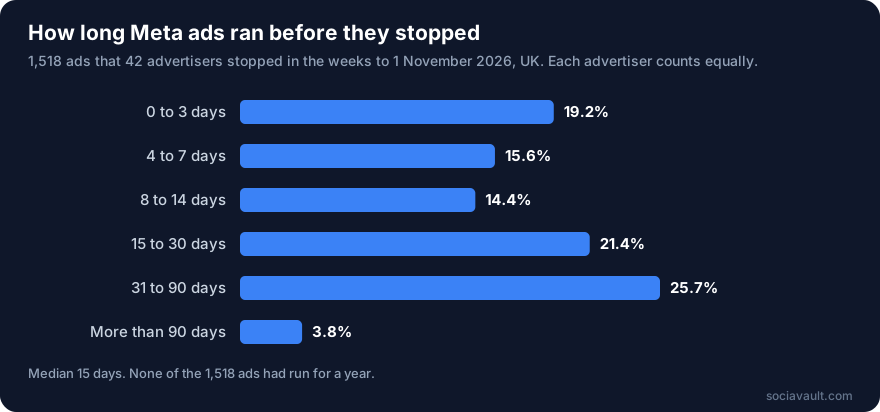
For each advertiser we asked the library for every ad it had stopped in a recent window, sized to how busy the advertiser is. For Calm, Boots and Gymshark, which each stop dozens of ads a day, that's the last day. For Pipedrive, which stops fewer than one, it's 37 days. Duolingo had only 74 stopped ads in the whole year, so we took all of them. Each advertiser counts equally, so Boots's 115 ads don't drown out Moneybox's 6.
The middle half of ads ran between 4 and 32 days. About a fifth were gone within three days. From the outside, that's what testing looks like: a brand launches a batch of versions, keeps a few running and switches off the rest.
Gymshark shows it clearly. 52 of its ads stopped on 31 October or 1 November, and 37 of those had only started on 29 October. Calm stopped 77 ads over the same two days, after a median run of 2 days. Across the past year Calm stopped 35,334 ads in the UK, close to 100 a day, while keeping 276 live.
Nearly three in four of the ads that stopped were dynamic creative, where Meta assembles each ad from the images and headlines the advertiser supplies. Their median was 15 days, the same as the whole set.
There's a second way to get a typical run length, straight from the library's totals. Gymshark keeps about 763 ads live and stops about 57 a day, which works out to an average run of about 13 days. Across all 42 advertisers, 9,663 live ads and 223,553 stopped in the past year give an average of about 16 days. Treat that as an estimate: it assumes a steady pace, and the live count is one day's snapshot. But it uses every ad in the library, and it lands within a day of the median.
Long-running Meta ads are rare
The library can also count how many of today's live ads were already running on a given date. Ask for an advertiser's live ads with a date range ending on 3 August 2026, and you get every live ad that had started by then. That's everything running for 90 days or more, counted exactly.
On 1 November that was 278 of the 9,663 live ads, or 2.9%. Only seven had passed a year: five from Booking.com, one from Secret Escapes and one from Pipedrive. Half the advertisers (21 of 42), including Boots, Canva, Airbnb and Monzo, had no live ad older than 90 days.
These were the longest runs we found:
| Advertiser | The ad | Ran | Days |
|---|---|---|---|
| HubSpot | "Free eBook Download", image ad | 25 Sep 2023 to 30 Jan 2026 | 858 |
| Secret Escapes | "Join now and get luxury travel for less" | Since 23 Jan 2025, still live | 647+ |
| Calm | Spanish-language free trial ad | 23 Oct 2024 to 17 Feb 2026 | 482 |
| Booking.com | "Grow your earning potential", for hosts | Since 15 Sep 2025, still live | 412+ |
| HubSpot | "Target ads. Boost sales.", image ad | 15 Nov 2024 to 17 Dec 2025 | 397 |
None of them is a sale. HubSpot is offering a free ebook and making a standing product pitch, Secret Escapes is selling a membership, Calm a free trial, and Booking.com is asking property owners to list with it. A seasonal offer has an end date built in. A free guide or a trial doesn't, so nothing forces a change.
If you treat "it's been running for months" as a sign that a competitor's ad works, as our guide to reverse-engineering winning ad angles does, the data says that's a high bar on Meta. Ninety days puts an ad in about the top 4% of what these brands ran. Thirty days is much less special: about 30% of stopped ads got there.
Google ads run for months, often years
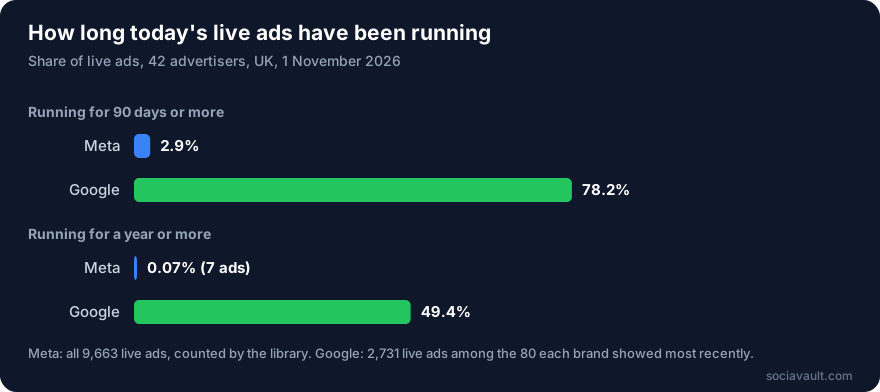
Google lists an advertiser's ads by when they were last shown, so the first pages are its live ads. We took the 80 most recently shown ads per brand and kept only the ones paid for by the brand's own accounts. That filter matters. A domain search for argos.co.uk mostly returned ads from other companies linking to Argos, so we pulled Argos's own advertiser ID instead.
Of the 2,731 live Google ads, about half had been running for more than a year, with a median age of 356 days. 78% had passed 90 days. 89 had a first-shown date of 25 or 26 October 2021, which looks like where Google's records start, so those ads may be older still. 52 of the 89 were Booking.com's.
Format explains a lot of it. Text ads, which on Google are mostly search ads, made up 2,220 of the 2,731. They had a median age of 464 days, and 56% had been running for over a year. Image ads had a median of 108 days, and video ads 62. A search ad can run unchanged for years while the bids and keywords around it change, and the library keeps showing it as the same creative.
For the 10 advertisers whose pull reached past their live ads into stopped ones, we can compare the same brands on both platforms. Their stopped Google ads had run a median of 29 days. Their stopped Meta ads: 8 days. And 47% of their live Google ads had passed 90 days, against 1.5% of their live Meta ads. If you want to pull a brand's Google ads yourself, our walkthrough of the Google Ad Library shows the endpoints.
How still-running ads change the numbers
A live ad hasn't finished, so its age is only a minimum. We kept live ads separate everywhere above, and the effect is very different on each platform.
On Meta, live ads are a small slice. These advertisers had 9,663 live against 223,553 stopped in the past year, so live ads were 4% of everything they ran. If every live ad had stopped on 1 November and we'd counted it, the share of ads that ran 90 days or more would move from 3.8% to 3.76%. They barely register.
On Google it's the reverse. 89% of the ads we pulled were live, because Google lists live ads first. Put everything into one median and you get 273 days, which mostly measures how old today's live ads are. The ones that had stopped ran a median of 28 days.
Any snapshot of live ads also has a built-in tilt. An ad that runs for three years is live on every day of those three years, while a one-week test is live for a week. So whatever's running on a given day over-represents long runners, on both platforms. Even with that tilt, fewer than 3% of live Meta ads had reached 90 days.
The first page of an ad library isn't a fair sample
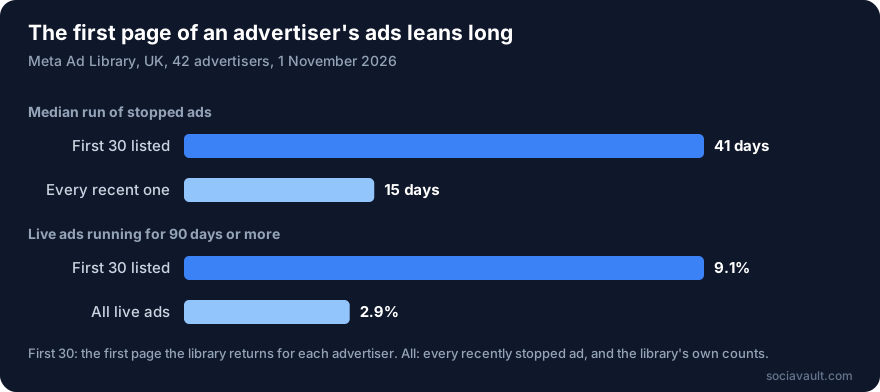
Our first pass got this wrong. We took the first page of stopped ads for each advertiser, 30 ads each, and got a median of 41 days. It looked plausible, and it was nearly three times too high.
The library doesn't list an advertiser's ads by date. Whatever order it uses, the first page leans toward long-running ads. Among the first 30 live ads per advertiser, 9.1% had been running for 90 days or more, while the exact count across all live ads was 2.9%. Moneybox is the extreme case: all 7 of its live ads older than 90 days sat on its first page of 30, out of 241 live.
Duolingo shows the same thing for stopped ads. It had 74 in the year, few enough to pull every page. The first page of 30 had a median run of 8 days. The other 44 had a median of 5.
So sorting a competitor's first page by start date to find their longest runners is fine. That's what the first page is good at. Just don't read their typical run length off it. Use the library's counts, or pull every ad from a recent window, as we did here.
Differences by category
| Category | Meta: median run, recently stopped | Meta: live ads past 90 days | Google: live ads past a year |
|---|---|---|---|
| Travel | 24 days | 4.4% | 62% |
| SaaS | 24 days | 3.0% | 54% |
| Retail | 18 days | 1.4% | 50% |
| Food and drink | 17 days | 4.3% | 39% |
| Finance | 16 days | 3.9% | 51% |
| Apps | 16 days | 0.2% | 54% |
| DTC brands | 4 days | 1.9% | 29% |
Travel ran longest on every measure, tied with SaaS on one. Booking.com's property sign-up ads and Secret Escapes's membership ads are the Meta examples, and on Google 93% of the travel brands' live ads had passed 90 days.
DTC brands were the opposite: a 4-day median on Meta, and only 29% of live Google ads past a year. Some of that is timing. 70% of the DTC ads that stopped in our window had launched in the last week of October, the same week Simba Sleep's Black Friday sale ads went live. Their full-year turnover points to an average of 15 to 18 days, close to everyone else. The 4 days says more about late October than about DTC brands in general.
Apps had the fewest long runners on Meta, with 1 of 420 live ads past 90 days, but plenty on Google. Calm drives most of the Meta figure: it had 276 of the category's 420 live ads, none of them past 90 days.
Six advertisers per category is a small panel, and the middle of the table could easily reshuffle in another month. Travel at the top is the result we'd trust most, because it held on every measure.
How to measure it yourself
This counts one advertiser's live and stopped Meta ads, checks how many live ones have passed 90 days, pulls every ad it stopped in the last 7 days and then reads the age of its live Google ads. In JavaScript (Node 18 or later, as an .mjs file):
const API = "https://api.sociavault.com/v1/scrape";
const HEADERS = { "x-api-key": process.env.SOCIAVAULT_API_KEY };
const DAY = 86400000;

// Lists can come back as arrays or as objects with numbered keys
const asList = (x) => (Array.isArray(x) ? x : Object.values(x ?? {}));
const sleep = (ms) => new Promise((resolve) => setTimeout(resolve, ms));
const daysAgo = (n) =>
  new Date(Date.now() - n * DAY).toISOString().slice(0, 10);
const median = (xs) => {
  const s = [...xs].sort((a, b) => a - b);
  const m = Math.floor(s.length / 2);
  if (!s.length) return null;
  return s.length % 2 ? s[m] : (s[m - 1] + s[m]) / 2;
};

async function get(path, params) {
  const res = await fetch(`${API}/${path}?${new URLSearchParams(params)}`, {
    headers: HEADERS,
  });
  if (!res.ok) throw new Error(`HTTP ${res.status}: ${await res.text()}`);
  await sleep(500);
  return (await res.json()).data ?? {};
}

// Meta: the UK library keeps stopped ads for about a year
const meta = (params) =>
  get("facebook-ad-library/company-ads", { country: "GB", ...params });

const live = await meta({ companyName: "HubSpot", status: "ACTIVE" });
const pageId = asList(live.results)[0]?.page_id;
if (!pageId)
  throw new Error(
    "No live ads found. Look up the page_id with search-companies.",
  );
const stopped = await meta({ pageId, status: "INACTIVE" });
const live90 = await meta({
  pageId,
  status: "ACTIVE",
  start_date: "2018-01-01",
  end_date: daysAgo(90),
});

const liveCount = live.searchResultsCount ?? 0;
const stoppedCount = stopped.searchResultsCount ?? 0;
console.log(
  `Meta: ${liveCount} live, ${stoppedCount} stopped in the past year`,
);
console.log(`Live for 90+ days: ${live90.searchResultsCount ?? 0}`);
if (stoppedCount)
  console.log(
    `Average run, estimated: ${((liveCount * 365) / stoppedCount).toFixed(1)} days`,
  );

// Every ad that stopped in the last 7 days, so the page order doesn't matter
const runs = [];
let cursor;
for (let page = 0; page < 3; page++) {
  const data = await meta({
    pageId,
    status: "INACTIVE",
    start_date: daysAgo(7),
    end_date: daysAgo(0),
    ...(cursor ? { cursor } : {}),
  });
  for (const ad of asList(data.results)) {
    if (ad.start_date && ad.end_date)
      runs.push(Math.round((ad.end_date - ad.start_date) / 86400));
  }
  cursor = data.cursor;
  if (!cursor) break;
}
console.log(
  `Stopped in the last 7 days: ${runs.length}, median run ${median(runs)} days`,
);

// Google: results come sorted by last shown, so live ads come first
const google = await get("google-ad-library/company-ads", {
  domain: "hubspot.com",
  region: "GB",
});
const now = Date.now();
const own = asList(google.ads).filter((ad) =>
  /hubspot/i.test(ad.advertiserName ?? ""),
);
const liveAges = own
  .filter((ad) => now - Date.parse(ad.lastShown) <= 2 * DAY)
  .map((ad) => (now - Date.parse(ad.firstShown)) / DAY);
console.log(
  `Google: ${liveAges.length} of ${own.length} ads live, median age ${Math.round(median(liveAges))} days`,
);
And in Python:
import os
import statistics
import time
from datetime import datetime, timedelta, timezone

import requests

API = "https://api.sociavault.com/v1/scrape"
HEADERS = {"x-api-key": os.environ["SOCIAVAULT_API_KEY"]}


def as_list(x):
    # Lists can come back as lists or as dicts with numbered keys
    return list(x.values()) if isinstance(x, dict) else (x or [])


def days_ago(n):
    return (datetime.now(timezone.utc) - timedelta(days=n)).strftime("%Y-%m-%d")


def get(path, params):
    r = requests.get(f"{API}/{path}", headers=HEADERS, params=params, timeout=120)
    r.raise_for_status()
    time.sleep(0.5)
    return r.json().get("data") or {}


def meta(params):
    # The UK library keeps stopped ads for about a year
    return get("facebook-ad-library/company-ads", {"country": "GB", **params})


live = meta({"companyName": "HubSpot", "status": "ACTIVE"})
results = as_list(live.get("results"))
if not results:
    raise SystemExit("No live ads found. Look up the page_id with search-companies.")
page_id = results[0].get("page_id")
stopped = meta({"pageId": page_id, "status": "INACTIVE"})
live90 = meta({"pageId": page_id, "status": "ACTIVE",
               "start_date": "2018-01-01", "end_date": days_ago(90)})

live_count = live.get("searchResultsCount") or 0
stopped_count = stopped.get("searchResultsCount") or 0
print(f"Meta: {live_count} live, {stopped_count} stopped in the past year")
print(f"Live for 90+ days: {live90.get('searchResultsCount') or 0}")
if stopped_count:
    print(f"Average run, estimated: {live_count * 365 / stopped_count:.1f} days")

# Every ad that stopped in the last 7 days, so the page order doesn't matter
runs, cursor = [], None
for _ in range(3):
    params = {"pageId": page_id, "status": "INACTIVE",
              "start_date": days_ago(7), "end_date": days_ago(0)}
    if cursor:
        params["cursor"] = cursor
    data = meta(params)
    for ad in as_list(data.get("results")):
        if ad.get("start_date") and ad.get("end_date"):
            runs.append(round((ad["end_date"] - ad["start_date"]) / 86400))
    cursor = data.get("cursor")
    if not cursor:
        break
print(f"Stopped in the last 7 days: {len(runs)}, "
      f"median run {statistics.median(runs) if runs else None} days")

# Google: results come sorted by last shown, so live ads come first
google = get("google-ad-library/company-ads", {"domain": "hubspot.com", "region": "GB"})
now = datetime.now(timezone.utc)
own = [ad for ad in as_list(google.get("ads")) if "hubspot" in (ad.get("advertiserName") or "").lower()]


def parse(ts):
    return datetime.fromisoformat(ts.replace("Z", "+00:00"))


live_ages = [(now - parse(ad["firstShown"])).total_seconds() / 86400
             for ad in own
             if ad.get("firstShown") and ad.get("lastShown")
             and now - parse(ad["lastShown"]) <= timedelta(days=2)]
print(f"Google: {len(live_ages)} of {len(own)} ads live, "
      f"median age {round(statistics.median(live_ages)) if live_ages else None} days")
When we ran both on 1 November 2026, they printed:
Meta: 46 live, 380 stopped in the past year
Live for 90+ days: 21
Average run, estimated: 44.2 days
Stopped in the last 7 days: 3, median run 0 days
Google: 32 of 32 ads live, median age 137 days
HubSpot is one of the slower movers in our sample. 21 of its 46 live Meta ads had passed 90 days, and its turnover estimate of 44 days is nearly three times the average. A run costs 5 credits for an advertiser this size. Busy advertisers stop more ads in a week than fit on one page, and later pages hold only 10 ads each, so shrink the window to a day or two for a brand like Boots. If a brand has no live ads, look up its page_id with search-companies first.
How we did it
- Sample: 42 advertisers, six per category. Retail: ASOS, Argos, John Lewis, Boots, Oliver Bonas, Lakeland. Apps: Duolingo, Spotify, Headspace, Strava, Calm, Flo. DTC brands: Gymshark, Huel, Simba Sleep, Bloom & Wild, Lounge Underwear, Wild. SaaS: HubSpot, Canva, monday.com, Shopify, Pipedrive, Xero. Finance: Revolut, Monzo, Wise, Starling Bank, Moneybox, Plum. Travel: Booking.com, Airbnb, easyJet, Jet2holidays, Trainline, Secret Escapes. Food and drink: Deliveroo, Just Eat, HelloFresh, Gousto, Domino's, Grind.
- Meta: the UK library, pulled on 1 November 2026. We matched each brand to its main UK page and checked the page name. Live and stopped totals are the library's own counts. Live ads past 90 days and past a year are exact counts of live ads that had started by 3 August 2026 and by 1 November 2025.
- Recently stopped Meta ads: every ad each advertiser stopped in a window ending 1 November, from 1 day for the busiest brands to 37 days, so the earliest window opened on 25 September. That's 1,518 ads. 25 of the 42 sets were complete. The other 17 had more ads than our page cap, so we have the first 30 to 115 of each. Each advertiser is weighted equally. Run length is the end date minus the start date in days, so an ad that started and stopped on the same day counts as 0.
- Dropped: three ads from 2021 and 2022 about carbon offsetting and rail travel that the library still lists, so that every stopped ad comes from the same year. They were also the only ads with a spend range.
- Google: the UK region, the 80 ads each brand showed most recently, found by domain (by advertiser ID for Argos and Lounge Underwear), keeping only ads from the brand's own accounts. That left 2,731 live ads from all 42 advertisers and 336 stopped ads from the 10 whose pull reached them.
- Spend: none. Google's results have no spend field, and Meta's
spendfield was empty for every ad we used, so we didn't estimate one. If you need a number, our guide to estimating ad spend from ad volume covers the rough methods and why they're estimates. - Cost: 339 credits, including the test runs of the scripts above.
Honest limits
- It's 42 brands, mostly big UK names, picked by hand. Smaller advertisers may behave differently, and six per category is enough to spot a direction and not much more.
- Most stopped-ad windows fall in late October. That's a busy time for creative swaps before Black Friday, which shows in the DTC numbers. The full-year turnover estimate (about 16 days) backs up the overall picture, but a category median from one window can swing.
- 17 of the 42 stopped-ad sets are partial. Where a window held more ads than we pulled, we have the first pages, which lean long. Using only the 25 complete sets gives a median of 14 days instead of 15.
- An "ad" isn't the same unit on both platforms. Meta lists every ad separately, including each test version. Google lists creatives, and a search ad can stay the same creative for years. Part of the gap between the platforms is how each one counts.
- Google's dates appear to start in late October 2021. The 89 ads at that date are at least five years old, possibly more.
- We saw only part of most brands' live Google ads. For 32 advertisers, every ad we pulled was live, so their list went on past our 80. Search ads get shown constantly, so they're likely over-represented among the most recently shown.
- We can't see why an ad stopped. A paused ad, a finished campaign and a replaced creative all look the same in the library.
- UK only. Meta's US library doesn't keep stopped commercial ads, so the Meta half of this method won't work there.
The category numbers, advertiser counts and longest-running ads are in the CSV download. You're free to reuse them with a link back to this page.
Frequently Asked Questions
How long do Facebook and Instagram ads usually run?
About two weeks for the brands we measured. Ads that 42 UK advertisers stopped in the weeks before 1 November 2026 had run a median of 15 days, and the middle half ran 4 to 32 days. Only 3.8% ran past 90 days.
How long should you run a Facebook ad before changing it?
There's no fixed rule, and the library can't show how well an ad did. What it does show is that these brands replace most ads within a month and keep a few for much longer. If an ad is still doing its job at 30 days, you're already in the minority that lasts that long.
How long do Google ads run?
Much longer than Meta ads. Half the live Google ads from our 42 brands had been running for over a year, and search text ads had a median age of 464 days. For the 10 brands where we could compare stopped ads, their Google ads ran a median of 29 days against 8 days on Meta.
Can you see how long a competitor's ad has been running?
Yes. Meta's Ad Library shows the date each ad started running, and in the UK and EU it keeps stopped ads for about a year. Google's Ads Transparency Center shows first-shown and last-shown dates. LinkedIn shows run dates only for some ads, mostly ones shown in Europe.
Does a long-running ad mean it's working?
Not for certain, since no library shows results. It does mean the advertiser kept paying for it, and on Meta that's rare: only 2.9% of the live ads we counted had run for 90 days or more. On Google, age says much less, because half of all live ads pass a year.
Why can't I see a competitor's old ads in the US Ad Library?
Meta's US library doesn't list commercial ads after they stop running. Ads shown in the UK or EU stay listed for about a year after they last ran, so switch the country to the UK or an EU country to see a brand's stopped ads.
Want to see how long your competitors keep their ads running? Sign up for 50 free credits and run the script above on the brands you watch.
Found this helpful?
Share it with others who might benefit
Ready to Try SociaVault?
Start extracting social media data with our powerful API. No credit card required.