YouTube Changed How It Counts Views. Here's What It Did to the Numbers
On 27 August 2026, YouTube changed what counts as a public view on long-form videos. A view now counts the moment a video starts to play, including autoplay and the preview that plays when you hover over a thumbnail. Shorts already worked this way.
We wanted to know how much that moved the numbers, so we compared videos published before and after the change on the same channels. Likes per view fell by 41%. Put the other way, a long-form video now shows roughly 1.7 times as many views for the same number of likes.
If you track YouTube views over time, price sponsorships per view, or compare engagement rates, your numbers changed in late August even if nothing else did.
What changed
YouTube announced it in its API revision history on 27 August 2026. Public view counts for long-form videos, Live and Shorts are now counted the same way:
| Metric | Counted when | Used for |
|---|---|---|
| View (changed) | The video plays its first frame, including autoplay and hover previews | The public view count everyone sees |
| Engaged view (unchanged) | Playback continues past the first frame, or someone clicks to play | Monetization and most YouTube Analytics metrics |
| Thumbnail impression (unchanged) | The thumbnail is shown | Feed-level reach |
Creators' earnings and YouTube Partner Program eligibility didn't change, because they're based on engaged views. What changed is the number on the public page, and that's the number every tool, report and API sees.
What we found
We looked at 57 channels that had published long-form videos both before the change (May to mid-August) and after it (from 28 August). On each channel, we compared likes per view for the newer videos against the older ones.
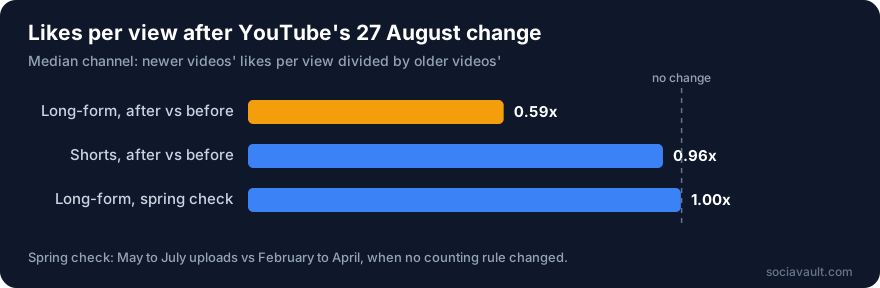
- Likes per view fell to 0.59 times the old level on the median channel. The middle half of channels fell to between 0.48 and 0.73 times.
- 95% of channels saw a drop. Comments per view fell by the same amount, to 0.60 times, on 89% of channels.
- Shorts barely moved, at 0.96 times. That's what you'd expect: Shorts have counted every play and replay since March 2025, so 27 August changed nothing for them.
- The same comparison a season earlier showed nothing. Videos from May to July against February to April, when no rule changed, came out at 1.00 times.
Likes and comments come from people who chose to watch, and the change didn't touch how those are counted. So when likes per view drops by 41% overnight on almost every channel, the view count is what grew.
There's one more reason to think the real effect is at least this big. The videos published after the change are younger: a median of 30 days old, against 106 days for the earlier ones. Newer videos usually have more likes per view, not fewer, because the first viewers are subscribers who are more likely to like. That bias works against the drop we found.
Who this affects
- Anyone with a YouTube time series. A channel's views will look like they jumped from late August. Mark 27 August 2026 as a break in the data.
- Engagement rates. Any engagement rate calculated per view fell. A creator who looked like a 4% performer may now look like 2.4%, with no change in their audience.
- Sponsorship pricing. Deals priced per view, or on cost per thousand views, now pay for a larger and softer number. Autoplay and hover previews count.
- Benchmarks. Our own Shorts vs long-form comparison from 2025 was measured under the old rules. Comparisons between Shorts and long-form are more even now, since both count starts.
What to do about it
- Split your data at 27 August 2026. Don't compare view counts or per-view rates across that date without adjusting.
- Lean on likes and comments. They weren't affected, so per-subscriber rates and raw like counts still compare cleanly over time.
- Ask for engaged views. For sponsored videos, ask the creator for engaged views from YouTube Studio's Advanced Mode. That's the number YouTube itself still uses for monetization.
- Use the ratio as a rough guide only. Across our channels, post-change view counts ran about 1.7 times what the old rule would have shown, but the middle half ranged from 1.4 to 2.1 times. Channels whose videos autoplay a lot on the home feed will see more.
Check a channel yourself
This pulls a channel's latest long-form videos and compares likes per 1,000 views before and after the change. In JavaScript (Node 18 or later, as an .mjs file):
const API = "https://api.sociavault.com/v1/scrape";
const HEADERS = { "x-api-key": process.env.SOCIAVAULT_API_KEY };
const CHANGE = new Date("2026-08-27T00:00:00Z");

// Lists can come back as arrays or as objects with numbered keys
const asList = (x) => (Array.isArray(x) ? x : Object.values(x ?? {}));
const median = (xs) => {
  const s = [...xs].sort((a, b) => a - b);
  const mid = Math.floor(s.length / 2);
  return s.length % 2 ? s[mid] : (s[mid - 1] + s[mid]) / 2;
};

const params = new URLSearchParams({ handle: "@mkbhd", sort: "latest" });
const res = await fetch(`${API}/youtube/channel-videos?${params}`, {
  headers: HEADERS,
});
if (!res.ok) throw new Error(`HTTP ${res.status}: ${await res.text()}`);
const data = (await res.json()).data ?? {};

const before = [];
const after = [];
for (const v of asList(data.videos)) {
  if (!v.viewCountInt || v.likeCountInt == null || !v.publishDate) continue;
  const rate = (v.likeCountInt / v.viewCountInt) * 1000;
  (new Date(v.publishDate) >= CHANGE ? after : before).push(rate);
}

const show = (xs) => (xs.length ? median(xs).toFixed(1) : null);
console.log("likes per 1,000 views before:", show(before));
console.log("likes per 1,000 views after: ", show(after));
And in Python:
import os
from datetime import datetime, timezone
from statistics import median

import requests

API = "https://api.sociavault.com/v1/scrape"
HEADERS = {"x-api-key": os.environ["SOCIAVAULT_API_KEY"]}
CHANGE = datetime(2026, 8, 27, tzinfo=timezone.utc)

def as_list(x):
    # Lists can come back as lists or as dicts with numbered keys
    return list(x.values()) if isinstance(x, dict) else (x or [])

r = requests.get(f"{API}/youtube/channel-videos", headers=HEADERS,
                 params={"handle": "@mkbhd", "sort": "latest"}, timeout=60)
r.raise_for_status()
videos = as_list((r.json().get("data") or {}).get("videos"))

before, after = [], []
for v in videos:
    if not v.get("viewCountInt") or v.get("likeCountInt") is None or not v.get("publishDate"):
        continue
    published = datetime.fromisoformat(v["publishDate"])
    rate = v["likeCountInt"] / v["viewCountInt"] * 1000
    (after if published >= CHANGE else before).append(rate)

print("likes per 1,000 views before:", round(median(before), 1) if before else None)
print("likes per 1,000 views after: ", round(median(after), 1) if after else None)
One call returns about 30 videos for 1 credit. The channel videos endpoint returns long-form uploads; channel Shorts returns Shorts and takes sort=newest.
How we did it
- Channels: 88 YouTube channels across 15 niches, from fitness to finance, found through YouTube search in October 2026.
- Videos: the latest 30 or so long-form uploads and latest Shorts on each channel, 2,468 long-form videos and 2,412 Shorts, pulled on 19 October 2026 with SociaVault's YouTube endpoints.
- Comparison: videos published 1 May to 19 August 2026 against videos published from 28 August that were at least 7 days old. We skipped the week around the change. For each channel with at least three videos on each side, we took the median likes per view on each side and divided after by before. 57 channels qualified.
- Checks: the same comparison for Shorts (22 channels) and for long-form videos one season earlier (29 channels).
- Cost: 191 credits for all the YouTube data.
Limits. This is a natural experiment, not a controlled test. Channels changed their content between the two periods, and our sample leans toward channels that YouTube search surfaced. The checks rule out a general drift in likes per view, but not every possible cause. The 1.7 times figure is a median across channels, not a rule for any one video.
Frequently Asked Questions
When did YouTube change how views are counted?
On 27 August 2026. Long-form videos and Live now count a public view when playback starts, as Shorts have since March 2025.
Does the change affect how much creators earn?
No. Monetization and YouTube Partner Program eligibility are based on engaged views and engaged watch hours, which didn't change.
Why did my YouTube engagement rate drop?
If you calculate engagement per view, the view count got bigger while likes and comments stayed the same. In our sample, likes per view fell by about 41% for videos published after 27 August.
Are YouTube view counts before and after 27 August comparable?
Not directly. Treat 27 August 2026 as a break. Compare likes, comments and subscriber-based rates instead, or adjust views with care.
Can I get engaged views through an API?
Only for your own channel, through YouTube Analytics. Public data, including YouTube's own Data API, shows the public view count.
Tracking YouTube channels for clients or research? Sign up for 50 free credits and run the check above on the channels you care about.
Found this helpful?
Share it with others who might benefit
Ready to Try SociaVault?
Start extracting social media data with our powerful API. No credit card required.