TikTok says it has tagged more than 3 billion videos with its AI-generated label since introducing it. That's a big number with no denominator. It doesn't tell a brand or a parent how often the label turns up when they search for a recipe or a cartoon.
So we measured it. On 1 November 2026 we ran 46 TikTok keyword searches across 23 everyday niches and read the label on every video uploaded in the previous three months: 2,358 videos from 1,954 accounts.
195 of them (8.3%) carried TikTok's AI-generated label. The average hides most of the story. Beauty, fashion, music and art had none. Kids' cartoons had 74%.
The numbers
- 8.3% of new videos carried the label (95% confidence interval 7.2% to 9.4%). By account it's the same: 162 of the 1,954 accounts had at least one labeled video in the sample.
- 3.5% in the typical niche. That's the median of the 23 niches, and it's the figure we'd quote. Leave kids' content out and the pooled share drops to 5.4%.
- TikTok applied 59% of the labels. Creators added the other 41% themselves.
- Accounts with a million or more followers almost never carried it: 1 video out of 219.
- Labeled videos showed no consistent engagement gap. They got 11% fewer likes per view than unlabeled videos in the same niche, and more comments and shares.
Every table in this post is in the CSV download, with the search terms and 95% intervals.
AI labels by niche
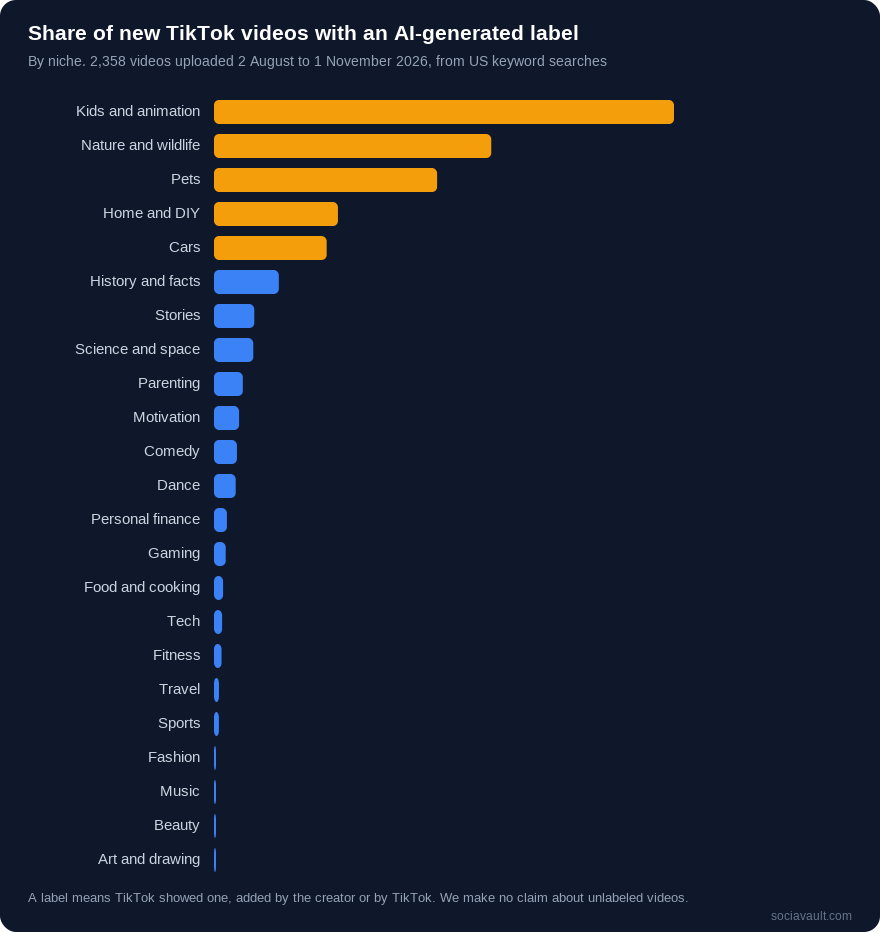
Kids' content is the outlier. 72 of the 97 kids' cartoon and nursery rhyme videos carried the label, and they came from 58 different accounts. No account had more than four labeled videos in the sample, so one busy channel isn't inflating the count. For the search "kids cartoon" alone, it was 53 of 63.
Animals and how-to videos come next: nature and wildlife (45%), pets (36%), home and DIY (20%) and cars (18%). The cars number comes almost entirely from one kind of video. 12 of 34 "car restoration" results carried the label, against 0 of 32 "car review" results.
At the other end, beauty, fashion, music and art had 0 labeled videos out of 455. Our read is that the label clusters where a video can be produced without anyone filming anything, and disappears where the creator's face, voice or hands are the point of the video.
Some niches rest on small samples. Pets is 25 videos and nature and wildlife 38, so treat those two shares as rough.
Who added the label
TikTok shows the label in two versions. "Creator labeled as AI-generated" means the creator switched on the AI-generated setting when they posted. "Contains AI-generated media" is the version TikTok applies itself. TikTok says it combines creator labels with its own detection models and C2PA Content Credentials, the metadata some AI tools write into the files they export.
In our sample, TikTok applied 116 of the 195 labels (59%) and creators added 79 (41%). The mix changes a lot by niche. TikTok applied 52 of the 72 labels on kids' content. Creators added 11 of the 12 in cars and 11 of the 17 in nature and wildlife.
Content credentials account for a small slice of TikTok's labels. Only 17 of the 116 TikTok-applied labels (15%) came with a C2PA or watermark marker in the response's c2pa_info object, and none of the creator labels did. Where the marker names a source, c2pa_info.first_aigc_src reads "Google LLC" (6 videos), "ChatGPT" (2), "TikTok" (2) or "Eleven Labs Inc." (1). For the other 99, the response doesn't say what triggered the label.
Big accounts rarely carry the label
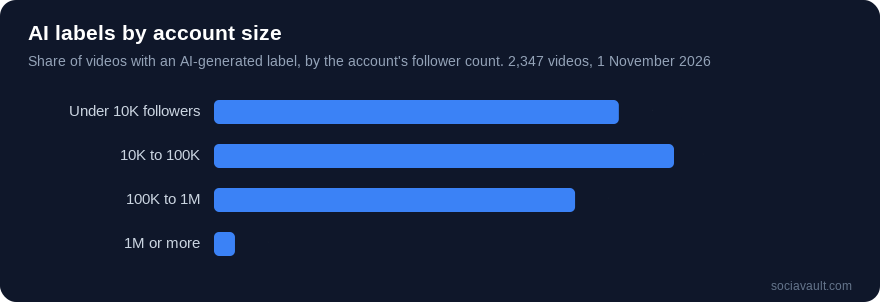
Below a million followers, the share barely moves: 8.9% under 10K, 10.1% from 10K to 100K and 7.9% from 100K to 1M. Above a million, it falls to 1 video in 219.
Part of that is where big accounts post. In our sample they clustered in food, tech, dance and fitness, which carry few labels anyway. So we worked out what the niche mix alone predicts. If accounts with 1M+ followers carried labels at the rate of smaller accounts in the same niches, we'd expect about 10 labeled videos. We found 1. That's a small count to hang a conclusion on, but it points the same way.
How labeled videos performed
Putting all labeled videos against all unlabeled ones gives a misleading answer. Pooled that way, labeled videos got about a third of the likes per view (2.8% against 8.3%). Most of that gap is niche mix: 37% of the labeled videos are kids' cartoons, where the median like rate is 1.6%, against 8.0% everywhere else.
So we compared each labeled video with the median unlabeled video in its own niche.
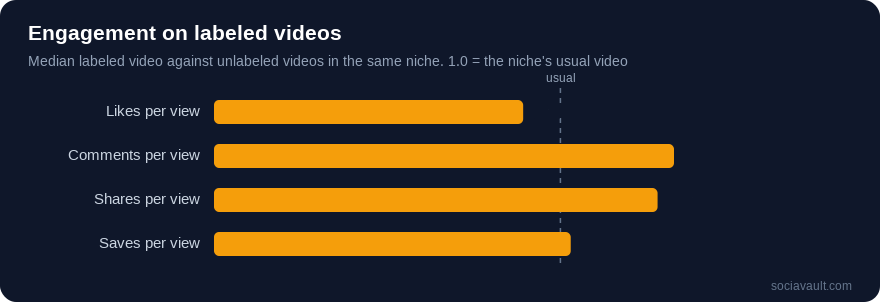
| Metric | Labeled video vs the niche's usual video |
|---|---|
| Likes per view | 0.89 |
| Comments per view | 1.33 |
| Shares per view | 1.28 |
| Saves per view | 1.03 |
| Views | 0.69 |
| Views per day since upload | 1.28 |
Likes per view ran 11% lower, while comments and shares ran higher. Views depend on how you treat age. Labeled videos were a little newer (a median of 9 days old, against 11), so they trail on total views and lead on views per day.
We wouldn't read any of this as the label's effect. Search ranking decided which videos we saw, and a labeled video differs from an unlabeled one in what it shows, as well as in the tag. For reach benchmarks without the AI angle, see our TikTok benchmarks from 6,600 videos and viral view thresholds by account size.
How we checked the label is real
A study like this is only as good as the field behind it, so we tested the field before pulling the sample. That took 7 credits: searches for "ai generated" and #aiart, two single videos through /tiktok/video-info, one creator's video list, and two calls to see which endpoints and settings drop the field.
Then we checked the sample against TikTok itself. We opened the public page of every labeled video and 100 unlabeled ones, logged out, 20 to 40 minutes after the pull. 277 pages returned the video's data, and 274 agreed with our API on whether the video was labeled: 192 of the 195 labeled videos and all 82 unlabeled ones. The other 3 showed no label on the page when we looked.
Searches for #aiart and "ai video" ran as a control. 43 of their 59 videos (73%) carried the label, which is what you'd expect if the field works. We don't count the rest either way, because a hashtag isn't proof of how a video was made.
Hashtag searches also agreed with keyword searches on recent uploads. Across 23 hashtag searches, one per niche, 36 of the 447 videos uploaded in the same three months were labeled (8.1%). For older uploads it was 10 of 437 (2.3%).
Reading the label from the API
The label lives in three fields on each TikTok video object:
| Field | What it holds |
|---|---|
aigc_info.aigc_label_type | 0 for no label, 1 for the creator's label, 2 when TikTok's systems labeled the video |
aigc_info.created_by_ai | true when the video carries either label. It matched the label on all 3,447 videos we pulled |
moderation_aigc_info.moderation_aigc_label_type | 1 when TikTok's systems flagged the video. The whole object is often missing, so read it carefully |
They come back on these endpoints:
| Endpoint | Where the video object sits |
|---|---|
/tiktok/video-info | data.aweme_detail |
/tiktok/videos | data.aweme_list |
/tiktok/search/keyword | data.search_item_list[].aweme_info |
/tiktok/search/hashtag | data.aweme_list |
Two things tripped us up.
Some responses don't carry the fields. /tiktok/search/top returns a shorter item format without them, and trim=true on the keyword search removed them too. Leave trim off when you need the label.
Type 2 doesn't mean the creator stayed quiet. When TikTok's systems flagged a video that the creator had already labeled, our API returned 2, while the public page kept the two signals apart and showed the creator's label. That was the case for 51 of the 167 videos with type 2. To count labeled videos, use created_by_ai. When you split creator labels from TikTok's, read 2 as "TikTok flagged it" and nothing more. The split earlier in this post uses what the public page shows.
This counts the labeled videos in a keyword search, at 1 credit per page and 2 pages at most. In JavaScript (Node 18 or later, saved as ai-labels.mjs):
// Count AI-labeled videos in a TikTok keyword search (Node 18+).
// Run: SOCIAVAULT_API_KEY=... node ai-labels.mjs "kids cartoon"
const API = "https://api.sociavault.com/v1/scrape/tiktok";
const HEADERS = { "x-api-key": process.env.SOCIAVAULT_API_KEY };
const MAX_PAGES = 2; // about 30 videos a page, 1 credit each

// Lists can come back as arrays or as objects with numbered keys
const asList = (x) => (Array.isArray(x) ? x : Object.values(x ?? {}));
const sleep = (ms) => new Promise((resolve) => setTimeout(resolve, ms));

// "creator", "tiktok" or null. Type 1 is the creator's own label. Type 2, or a
// moderation flag of 1, means TikTok's systems labeled it (the creator may have too).
function aiLabel(video) {
  const type = Number(video?.aigc_info?.aigc_label_type ?? 0);
  const flag = Number(
    video?.moderation_aigc_info?.moderation_aigc_label_type ?? 0,
  );
  if (type === 1) return "creator";
  if (type === 2 || flag === 1) return "tiktok";
  return null;
}

const query = process.argv[2] ?? "kids cartoon";
const videos = new Map();
let cursor;
for (let page = 0; page < MAX_PAGES; page++) {
  // no trim=true: the trimmed response drops the label fields
  const params = new URLSearchParams({
    query,
    date_posted: "last-3-months",
    region: "US",
  });
  if (cursor !== undefined) params.set("cursor", cursor);
  const res = await fetch(`${API}/search/keyword?${params}`, {
    headers: HEADERS,
  });
  if (!res.ok) throw new Error(`HTTP ${res.status}: ${await res.text()}`);
  const data = (await res.json()).data ?? {};
  for (const item of asList(data.search_item_list)) {
    const video = item?.aweme_info;
    if (video?.aweme_id) videos.set(video.aweme_id, video);
  }
  if (!data.has_more || data.cursor == null) break;
  cursor = data.cursor;
  await sleep(500);
}

const all = [...videos.values()];
const labeled = all.filter((v) => aiLabel(v));
const pct = all.length ? ((100 * labeled.length) / all.length).toFixed(1) : "0";
console.log(
  `"${query}": ${labeled.length} of ${all.length} videos carry an AI-generated label (${pct}%)`,
);
console.log(
  `  creator's label (type 1): ${labeled.filter((v) => aiLabel(v) === "creator").length}`,
);
console.log(
  `  TikTok's systems (type 2): ${labeled.filter((v) => aiLabel(v) === "tiktok").length}`,
);
And in Python:
# Count AI-labeled videos in a TikTok keyword search.
# Run: SOCIAVAULT_API_KEY=... python3 ai_labels.py "kids cartoon"
import os
import sys
import time

import requests

API = "https://api.sociavault.com/v1/scrape/tiktok"
HEADERS = {"x-api-key": os.environ["SOCIAVAULT_API_KEY"]}
MAX_PAGES = 2  # about 30 videos a page, 1 credit each


def as_list(x):
    # Lists can come back as lists or as dicts with numbered keys
    return list(x.values()) if isinstance(x, dict) else (x or [])


def ai_label(video):
    # "creator", "tiktok" or None. Type 1 is the creator's own label. Type 2, or a
    # moderation flag of 1, means TikTok's systems labeled it (the creator may have too).
    label_type = int((video.get("aigc_info") or {}).get("aigc_label_type") or 0)
    flag = int((video.get("moderation_aigc_info") or {}).get("moderation_aigc_label_type") or 0)
    if label_type == 1:
        return "creator"
    if label_type == 2 or flag == 1:
        return "tiktok"
    return None


query = sys.argv[1] if len(sys.argv) > 1 else "kids cartoon"
videos = {}
cursor = None
for page in range(MAX_PAGES):
    # no trim=true: the trimmed response drops the label fields
    params = {"query": query, "date_posted": "last-3-months", "region": "US"}
    if cursor is not None:
        params["cursor"] = cursor
    r = requests.get(f"{API}/search/keyword", headers=HEADERS, params=params, timeout=90)
    r.raise_for_status()
    data = r.json().get("data") or {}
    for item in as_list(data.get("search_item_list")):
        video = (item or {}).get("aweme_info") or {}
        if video.get("aweme_id"):
            videos[video["aweme_id"]] = video
    if not data.get("has_more") or data.get("cursor") is None:
        break
    cursor = data["cursor"]
    time.sleep(0.5)

labeled = [v for v in videos.values() if ai_label(v)]
share = 100 * len(labeled) / len(videos) if videos else 0
print(f'"{query}": {len(labeled)} of {len(videos)} videos carry an AI-generated label ({share:.1f}%)')
print(f"  creator's label (type 1): {sum(ai_label(v) == 'creator' for v in labeled)}")
print(f"  TikTok's systems (type 2): {sum(ai_label(v) == 'tiktok' for v in labeled)}")
When we ran both on 1 November 2026, they printed the same thing:
"kids cartoon": 12 of 22 videos carry an AI-generated label (54.5%)
  creator's label (type 1): 0
  TikTok's systems (type 2): 12
That's well below the 84% we got for the same search in the study, and it's a fair warning about single runs. Search results shift from one request to the next, and 22 videos is a small sample. For a number you can rely on, pool several searches and several pages, the way the study did.
To vet one creator instead of a niche, call /tiktok/videos with their handle and run the same aiLabel check over data.aweme_list. And if you need to judge a single video, the label is only one signal. Our guide to detecting AI-generated content covers the others.
How we did it
- Searches: 23 niches with two keyword searches each, 46 in total, through
/tiktok/search/keywordwithdate_posted=last-3-monthsandregion=US, up to three pages per search. One search ("weight loss journey") returned no videos, and a few others ran out after one or two pages. Every search term is in the CSV. - Sample: 2,358 unique videos uploaded between 2 August and 1 November 2026. We dropped 153 older videos that came back despite the date filter.
- Account size: the follower count on each result at the time of the pull. 11 videos had none and are left out of that chart.
- Cross-check: one hashtag search per niche, two pages each, 884 videos of any age. 882 of them came back with a follower count of 0, so hashtag results aren't in the account-size numbers.
- When: 1 November 2026, 21:53 to 22:01 UTC, with the field check earlier that evening and the public-page check right after.
- Cost: 186 credits in total: 173 search pages, 7 for the field check and 6 to test the code in this post.
What this can't tell you
- Search results aren't all of TikTok. We measured what TikTok search returned for 46 everyday queries from a US location. Search favors popular videos, and the niches we picked drive the pooled figure. That's why we'd quote the 3.5% median niche before the 8.3% pooled share.
- A label isn't a measure of AI use. TikTok asks creators to label realistic AI content, and its systems label some videos on their own. We make no claim about unlabeled videos. A video without the label isn't proof a person made it, and a video with one may only contain a few AI-made elements.
- Labels change. Creators can add one after posting, and TikTok can apply one later. 3 of our 195 labels weren't on the public page 20 to 40 minutes after the pull. Treat this as a snapshot from 1 November 2026.
- The creator and TikTok split comes from the public page, because the API's type 2 covers both cases.
- Small niches are noisy. The CSV has a 95% interval for every niche. Pets, at 25 videos, runs from 20% to 55%.
- The engagement comparison is correlation. We can't separate the label from the kind of video that gets labeled.
Frequently Asked Questions
What percentage of TikTok videos are AI-generated?
Nobody can measure that from outside TikTok, but you can measure the label. In our sample, 8.3% of 2,358 videos uploaded between August and November 2026 carried TikTok's AI-generated label, and the median niche was 3.5%. It ranged from none in beauty, fashion, music and art to 74% in kids' cartoons.
How can you tell if a TikTok video is AI-generated?
Look under the caption. "Creator labeled as AI-generated" means the creator disclosed it, and "Contains AI-generated media" means TikTok applied the label. A missing label proves nothing either way. For other signals, see our guide to detecting AI-generated content.
What's the difference between "Creator labeled as AI-generated" and "Contains AI-generated media"?
The first is the creator's own disclosure, switched on when they post. The second is applied by TikTok, which says it uses its own detection models and C2PA Content Credentials. In our sample, TikTok applied 59% of the labels.
Does an AI-generated label hurt a video's reach on TikTok?
We didn't see a consistent penalty. Against unlabeled videos in the same niche, labeled ones had 11% fewer likes per view but 33% more comments and 28% more shares per view. They had fewer total views and more views per day, because they were newer. None of that isolates the effect of the label itself.
Can I get TikTok's AI label through an API?
Yes. Video objects from SociaVault's /tiktok/video-info, /tiktok/videos, /tiktok/search/keyword and /tiktok/search/hashtag endpoints include aigc_info.aigc_label_type, aigc_info.created_by_ai and, when TikTok flagged the video, moderation_aigc_info. Leave trim off, because the trimmed response drops them.
Which TikTok niches have the most AI-labeled videos?
In our November 2026 sample: kids and animation (74%), nature and wildlife (45%), pets (36%), home and DIY (20%) and cars (18%). Beauty, fashion, music and art had no labeled videos at all.
Tracking AI labels in your own niche, or vetting a creator before a deal? Sign up for 50 free credits and run the script above on your own searches.
Found this helpful?
Share it with others who might benefit
Ready to Try SociaVault?
Start extracting social media data with our powerful API. No credit card required.